Latest research on the "3x3 magic square of squares"
problem
This page presents the most interesting studies on the Open
problems 1 and 2 done after the publication of my article "Some
notes on the magic squares of squares problem" in 2005. The two corresponding prizes are
still to be won!
- $100 prize offered by Martin
Gardner since 1996, on problem 1
- €1,000 prize + a bottle of champagne
since 2010 (was only €100 from 2005 to 2009), on my "easier" sub-problem 2 = enigma
1
If you want to study these two problems, I STRONGLY recommend that you first:
- read the above Mathematical Intelligencer paper,
- read these 5 earlier references (download
the 5 PDF files from [8] to [12]): [8]+[9] Christian Boyer,
[10]+[11] Andrew Bremner, [12] Duncan Buell
- read also [49] Landon
Rabern's paper and below improvements by Lee
Morgenstern on 3x3 magic squares of squares properties
- see the PowerPoint presentation
summarizing the paper and the above references < 2005
- and, of course, read the latest results in this page! From Ajai
Choudhry, Randall Rathbun, Jean-Claude Rosa, Lee Morgenstern,
Lucien Pech, Landon Rabern, Frank Rubin, Lee Sallows, Ant King, Mike
Winkler, Tim S. Roberts, Mark Underwood, Paul Zimmermann,
Paul Pierrat, François Thiriet, Terry Moriarty, Eddie
Gutierrez, Matt Parker with Brady Haran, Ben Asselstine, Christian Woll, Joseph Hurban, Adrian Suter, Benjamin Bartsch,
Giancarlo Labruna, Vlad Volosatov, Arkadiusz Wesolowski, Onno Cain, Sunil Kumar.
Send
me your new results, they will be added if interesting.
Received March 6, 2006
Ajai Choudhry, India, constructed some
3x3 squares with 7 correct sums, their magic sums not being a square. For example:
|
7656²
|
14543²
|
16764²
|
|
18127²
|
14916²
|
264²
|
|
12804²
|
10824²
|
16433²
|
Interesting, because most of the 3x3 squares with 7 correct sums
come from the Lucas family, in which the magic
sum is a square. The first known example with a non-square magic sum
was constructed by Michael Schweitzer (Fig MS4 of the M.I. article).
It would be very interesting to find a parametric solution with a non-square
magic sum, generating an infinite number of 3x3 squares. With such a new parametric
solution, it should be easy to check mathematically if this family can or cannot
produce a solution with 8 magic sums. The Lucas family is unfortunately
proved unable to produce 8 magic sums.
Received October 10th, 2006
Message from Randall Rathbun,
USA, on the Open problem 2:
"I wore out the meccah high speed calculation cluster at Harvard
University trying, but no success. Spent weeks running the code, but nothing
more turned up than the 1 example that Dr Andrew Bremner found.
Quite
discouraging, actually"
Several years before this problem 2, Randall already worked on Gardner's
challenge (=our open problem 1). It was in 1999, look at:
Received November 5th, 13th, 23rd, 2006
Jean-Claude Rosa,
France, constructed this 3x3 semi-magic square (with 6 correct sums) using only
odd numbers. Interesting, because most of the 3x3 semi-magic squares use both odd
and even numbers. Strange: in this smallest possible example, all the numbers
used are squares of primes.
|
11²
|
23²
|
71²
|
|
43²
|
59²
|
19²
|
|
61²
|
41²
|
17²
|
Using these 3 primitive Pythagorean triangles having the same area:
- 1380² + 19019² = 19069²
- 3059² + 8580² = 9109²
- 4485² + 5852² = 7373²
he constructed this 3x3 square (with 7 correct sums) using only odd numbers.
6 of its 9 numbers are squares of primes.
|
5521²
|
10337²
|
19069²
|
|
20399²
|
9109²
|
1367²
|
|
7373²
|
17639²
|
11639²
|
And using other Pythagorean triangles having the same area, he produced
this other square (with 7 correct sums) using only odd numbers. The magic sum
is smaller than the previous square.
|
14393²
|
2171²
|
13507²
|
|
12181²
|
10517²
|
11633²
|
|
6227²
|
16703²
|
8749²
|
Received November 30th, 2006
Theorem from Lee Morgenstern,
USA: "In a 3x3 magic square of distinct squares, the smallest square cannot
be 1."
Received December 10th, 2006
Only some days after Lee Morgenstern,
Jean-Claude Rosa independently proved that a 3x3 magic square can't be
constructed using 1 and eight squares of odd numbers.
Received December 19th, 2006
From Lee Morgenstern, USA,
far extending his previous proof excluding 1: "if
there is a 3x3 magic square of distinct squares, then all entries must
be above 10^14."
Received December 23rd, 2006
Lucien Pech, when he was a "Mathématiques
Spéciales" student, school year 2005-2006, chose the "3x3 magic square
of squares" as the subject for his TIPE: Travaux d'Initiative Personnelle
Encadrés = supervised personal search. He searched for a magic hourglass;
such a solution would solve the Open problem 2, since it uses 7 squares. He
used Duncan Buell's method (see reference [12], top of this page),
but didn't find any solution to this very difficult problem. His best result
is an excellent modulo 2^52 example, better than Duncan Buell's
modulo 2^46 example.
Lucien Pech, now a student at the ENS Paris (Ecole Normale Supérieure, rue
d'Ulm), sent this revised version of his TIPE:
Received July 21st, 2007. Updated results received
October 18th, 2007.
After his
paper published in 2003 [49] on
the magic squares of squares problem, Landon Rabern, USA, searched for
a
3x3 magic square having at least 7 squared integers. Using a similar method as
my study of 2004 [8], he didn't find
any new example different from the only
known example.
You can download and use his Windows application with any other range
of center cells, even though he doesn't provide any explanation on its use (unfortunately):
http://landon314.brinkster.net/MagicSearcher.zip.
This application needs the Microsoft .NET Framework. The code sources are provided.
Received April 8th and 12th, 2008.
From Lee Morgenstern,
USA, the complete formula for all 3x3 semi-magic squares of squares (better
than the Lucas formula producing some, but not
all, 3x3 semi-magic squares of squares), and a list of 3x3 semi-magic squares
with 7 correct sums and using odd entries (including the two first smallest
squares given above by J.-C. Rosa in 2006):
Received February 6th, 2009.
From Lee Morgenstern,
USA: "We know that the magic sum of a 3x3 fully-magic square must be three
times the central entry. Are there any 3x3 semi-magic squares of squares with
a magic sum of three times any square? Looking over the published results, such
as with the Lucas formula, all the magic sums are squares.The new non-square
magic sums that you published on your previous update weren't three times a
square. I searched for 3x3 semi-magic squares of squares and found 20 of them with
a magic sum that is three times a square (searched up to a magic sum of 3 x
5000²). One of them, the smallest, had a magic sum which was three times one
of the actual entries. Since you can rearrange rows and columns to make another
semi-magic square, any of the entries can become the central one. So here is
my 3x3 semi-magic square of squares having a magic sum which is three times
the central entry (S = 3 x 1105²). This is the only known solution."
|
1751²
|
155²
|
757²
|
|
595²
|
1105²
|
1445²
|
|
493²
|
1555²
|
1001²
|
For his other 19 solutions, the magic sum was three times a square different
from any of the entries. Their sums (< 3 x 5000²) are 3 x 1225², 1275²,
1533², 1955², 1989², 2125², 2265², 2335², 2345², 2675², 3395², 3485², 3515²,
3575², 3655², 3765², 3885², 3995², 4193². Here is the example S = 3 x 1225²:
|
2105²
|
25²
|
265²
|
|
235²
|
1877²
|
961²
|
|
125²
|
989²
|
1873²
|
Received from May 17th to July 27th, 2009.
Frank Rubin (http://contestcen.com/)
worked
on 3x3 semi-magic squares of squares having 7 magic sums, only one
diagonal being not magic. With Sd1 = magic sum = sum of the magic diagonal,
and Sd2 = sum of the non-magic diagonal, Frank searched for squares having
the best possible ratio Sd1/Sd2 ~ 1.
Using Lee Morgenstern's method for finding 3x3 nearly-magic squares
of squares with close sums, here is one of the impressive
squares computed by Frank Rubin:
|
32004859810489663461722097429913882²
|
6566314229570234516482551556735538²
|
28680635830907835745130420028727601²
|
|
20694684230850857980455894108812542²
|
25099843330956651396728662500908321²
|
28839804352015135412123656375760542²
|
|
20914717277840113725279028899813359²
|
34883918758013437522259135104857422²
|
15352303377279966158185135232591402²
|
Sd1 = 1890006405715707401173356334328966702876471825085875343146504267674569
Sd2 = 1890006405715707267778636165444057741201927206436686602706450141117123
Sd1/Sd2 = 1.0000000000000000705... Very close to 1... And Sd1/Sd2 = 1 would
be a solution of this 3x3 magic square of squares problem!
Noticing that the magic sum is a square (S = Sd1 = 43474203911235768609981537098048163²),
I thought that Rubin's square was simply a member of the Lucas
family.
January 22nd 2010, mentioning my
feeling to Randall Rathbun,
he confirmed, finding (p, q, r, s) = (51498645679307420, 68881590670955891,
80839778471595961, 171878882029570731).
It is known that unfortunately this
family can't produce a 3x3 magic square of squares.
Received January 26th, 2010.
Here is Lee
Morgenstern's method, above used by Frank Rubin in May-July 2009
for 3x3 nearly-magic squares
of squares with close sums. This method uses Hillyer's formula of Pythagorean
Triangles having equal areas, and Newton's method of finding a root of a polynomial:
Received March 2nd-3rd, 2010.
Randall Rathbun made a serious attempt to solve the enigma
#1, searched for a 3x3 magic square having 7 squared entries, different from
the only known example. He created more than 116,000,000 magic squares
having 6 squared entries, looking to see if their 7th, 8th or 9th entries
was a squared integer. But alas, no new solution!
Received April 8th, 2010.
Interesting remark by Lee Sallows
on the enigma #1: it is possible to construct a 3x3 magic square having 7 squared
entries, if we allow... allow from SallowS ? ;-)... Gaussian
integers! Here is his nice example having a null magic sum, the two non-squared
entries being 6 and -6:
|
(1+2i)²
|
(-2+2i)²
|
(2+i)²
|
=
|
-3+4i
|
-8i
|
3+4i
|
|
6
|
0²
|
-6
|
6
|
0
|
-6
|
|
(-1+2i)²
|
(2+2i)²
|
(2-i)²
|
-3-4i
|
8i
|
3-4i
|
Can somebody construct a 3x3 magic square having 8 or 9 distinct squared Gaussian
integers?
Received October 15th, 2010
Here is Lee
Morgenstern's method for finding 3x3 magic squares with 7 distinct square entries.
This method would be (perhaps?) able to solve the enigma
1.
Received May 27th, 2011
Ant King
(www.mathstutoring.co.uk) constructed
this nice parametric solution of 3x3 semi-magic squares of squares using a single
variable, and only one diagonal is not magic. Because its magic sum is a squared
integer [3(1+ 3k + 3k²)²]², this parametric solution unfortunately
can't produce magic squares of squares (needing a magic sum equaling three times
a squared integer, or more precisely three times its center).
|
(2 +14k + 37k2 + 42k3
+18k4)2
|
(−2 −8k − 7k2
+ 6k3 + 9k4)2
|
(1+10k + 29k2 + 36k3
+18k4)2
|
|
(2 +12k + 29k2 + 30k3
+ 9k4)2
|
(1+ 6k +19k2 + 30k3
+18k4)2
|
(2 +12k + 29k2 + 36k3
+18k4)2
|
|
(−1− 2k + 7k2 + 24k3
+18k4)2
|
(2 +16k + 43k2 + 48k3
+18k4)2
|
(2 +10k +19k2 +18k3
+ 9k4)2
|
Received from November 15th 2011 to January 27th 2012
Lee
Morgenstern sent various interesting remarks and results:
For example, in the last but one document, he extended the above remark of
Lee Sallows on Gaussian integers.
And in the last document, he constructed a magic square of squares
modulo 2^90, therefore better than previous magic hourglasses of squares by Duncan Buell
and Lucien Pech (respectivelly mod 2^46 and mod 2^52).
Received March 2nd, 2012, updated May 6th, 2012,
updated again August 21st, 2012
Mike Winkler
(www.mikewinkler.co.nf),
using Morgenstern's above remark of Feb. 2009, searched
for 3x3 semi-magic squares having a magic sum which is three times
a square.
His search with Delphi was done with magic sum < 3 x 320000²,
but in a non-exhaustive way. He found 7 out of the 20 solutions previously found
by Morgenstern < 3 x 5000², and also these new bigger solutions. Sums
= 3 x 6115²,
7395²,
8905²,
9345²,
9565²,
9995², 10195², 12725²,
13175², 13765², 14825²,
15225²,
15525²,
16185²,
18085², 18115², 20085²,
22425²,
25075², 26571²,
28135², 32625²,
37635²,
41905², 41925², 42415², 44353²,
45025², 45435²,
49045², 63495², 76075², 77435², 87135², 117725², 123335², 124845², 140675², 141865²,
157675²,
195925², 196775², 227035², 264265², 319685². But no new solution with sum three times the central entry.
Received January 21st, 2013
Lee Morgenstern
reused his method sent in April 2008 concerning the
list of 3x3 nearly-magic squares of squares having all odd entries and 7 correct
sums. This is equivalent to three 3-square arithmetic progressions having equal
step values. The idea was to look for instances that satisfy the requirements
of a 3x3 fully-magic square of squares. The 2008 results were based on two searches:
- All odd-entry APs, primitive and scaled, up to a step value of d = 1.4
x 10^10.
- All primitive APs up to d = 10^19.
His new 2013 searches extended the above:
- up to d = 2.4 x 10^19.
- up to d = 6.4 x 10^22.
Received July 2nd and August 8th, 2013
Tim S. Roberts, Bundaberg, east coast of Australia, author of http://unsolvedproblems.org,
reminds us that a 3x3 magic square of squares must have this parametric form of
any 3x3 magic square:
|
a²
|
b²
|
c²
|
=
|
x+y
|
x-y-z
|
x+z
|
|
d²
|
e²
|
f²
|
x-y+z
|
x
|
x+y-z
|
|
g²
|
h²
|
i²
|
x-z
|
x+y+z
|
x-y
|
As an example, we will look at the modulo 13. Any squared integer can
only have one of these 7 "authorized" values, the quadratic residues mod 13: 0, 1,
3, 4, 9, 10, 12. If we check by program all the possible values
(x, y, z) mod 13, the nine cells (x+y), (x-y-z), ...(x-y) can
be nine squares (meaning that none of them is equal to another value than the 7 authorized
values) only when (x, y, z) = (x, y, 0) or (x, 0, z): we conclude that y or z must
be divisible by 13. Also equivalent is to say that y*z must be divisible by
13. Here are the final astonishing results that I have checked and slightly
extended (5 -> 5^2, and 7 -> 7^2):
- y*z must be divisible by 2^6 * 3^2 * 5^2 * 7^2 * 11 * 13 * 19 * 31 = 59,430,571,200.
- x*y*z must be divisible by 59,430,571,200 * 17 * 29 * 37 = 1,084,073,049,259,200.
Yes, x*y*z must be divisible by every prime < 40, with the sole exception
of 23.
Received from August 10th to September 3rd, 2013
Tim S. Roberts, again using the above parametric form of any
3x3
magic square, remarked that:
- at least one element of (x, y, z, y+z, y-z) must be divisible by 2
- at least one element of (x, y, z, y+z, y-z) must be divisible by 3
- at least one element of (x, y, z, y+z, y-z) must be divisible by 4
- and so on... at least one element must be divisible by 2, 3, 4,
5, 6, 7, 8, 9, 10, 11, 12, 13, 14, 15, 16, 17, 18, 19, 20, 21, 22, 23, 24,
26, 28, 29, 30, 31, 33, 34, 36, 37, 38, 39, 40, 41, 42, 43, 44, 46, 47,
48, 51, 52, 53, 56, 57, 60, 61, 62, 66, 67, 68, 69,...
Astonishing! An incredibly long list, where 25 is the first integer
> 1 not present. We can extend and finish his list, and say:
- at least one element of (x, y, z, y+z, y-z) must be divisible by
2, 3, 4, 5, 6, 7, 8, 9, 10, 11, 12, 13, 14, 15, 16, 17, 18, 19, 20, 21,
22, 23, 24, 26, 28, 29, 30, 31, 33, 34, 36, 37, 38, 39, 40, 41, 42, 43,
44, 46, 47, 48, 51, 52, 53, 56, 57, 60, 61, 62, 66, 67, 68, 69, 72, 76,
78, 84, 86, 88, 92, 93, 94, 102, 104, 114, 120, 124, 129, 132, 134, 136,
138, 141, 152, 156, 168, 172, 184, 186, 188, 201, 204, 228, 248, 258, 264,
268, 276, 282, 312, 344, 372, 376, 402, 408, 456, 516, 536, 552, 564, 744,
804, 1032, 1128, 1608.
This should be the full list, a total of 106 integers. All these integers
can be factorized with these primes only (or powers of them): 2 (4, 8,
16),
3 (9), 5, 7, 11, 13, 17, 19, 23, 29, 31, 37, 41, 43, 47, 53, 61, 67.
That
is to say, every prime < 70, with the sole exception of 59. We can also
say that:
- x*y*z*(y+z)*(y-z) must be divisible by 2^4 * 3^2 * 5 * 7 * 11 * 13 *
17 * 19 * 23 * 29 * 31 * 37 * 41 * 43 * 47 * 53 * 61 * 67 = 3196605376710617107476240.
Received from December 18th 2013 to January 8th,
2014
Mark Underwood, Canada, sent to Tim S. Roberts an interesting
remark improving the above results: y and z must both be divisible
by 24, then so too must be y+z and y-z. So the product of all four must be divisible
by 24^4, which is 2^12 * 3^4. And at least one of the items must be divisible
by 16, and at least one by 9. So that brings it up to 2^13 * 3^5.
And if I add my previous remark of July-August 2013 that y*z must be divisible
by 5^2 * 7^2, then:
- x*y*z*(y+z)*(y-z) must be divisible by 2^13 * 3^5 * 5^2 * 7^2 * 11 *
13 * 17 * 19 * 23 * 29 * 31 * 37 * 41 * 43 * 47 * 53 * 61 * 67 = 1546645545467664981281303961600.
Divisible
by an integer as big as ~ 1.5 * 10^30...
Received February 7th and 22nd, 2014
Lee Morgenstern extended again his previous searches of January
2013 and April 2008. No solution :
- up to d = 2.4 x 10^21.
- up to d = 6.0 x 10^23, the primitive step values being 4mn(m²-n²),
with m,n coprime, one odd, one even, and n < m < 2^24.
Received June 30, 2014
Lee Morgenstern completed three new searches
for a magic hourglass, but found no solution.
Received September 16, 2014
Received from February 19 to March 13, 2015
Paul Zimmermann, researcher (INRIA, LORIA, http://www.loria.fr/~zimmerma/),
with two young students, Paul Pierrat and François Thiriet, proved
these modular properties: the magic sum of any primitive 3x3 magic square
of squares must be 3 mod 72, and the squared entries must be 1 mod 24. And extending
Buell's and Pech's previous searches, they found modulo 2^n solutions for 3x3
magic squares of 7 squares, up to modulo 2^59.
Their paper is available at http://www.loria.fr/~zimmerma/papers/squares.pdf
Received July 25, 2015
Terry Moriarty, Northern Ireland, found some properties of
3x3 magic squares of squares. For example, their magic sums are 3 mod 72. Look at
http://magicsqr.byethost8.com/
Received April 16, 2016
Allowing imaginary numbers (see also above), Eddie
Gutierrez, New Jersey, USA, found 3x3 magic squares having 7 squared entries.
For example,
this square with magic sum = 15552:
|
113²
|
(121i)²
|
132²
|
=
|
12769
|
-14641
|
17424
|
|
9839
|
72²
|
23²
|
9839
|
5184
|
529
|
|
(84i)²
|
25009
|
(49i)²
|
-7056
|
25009
|
-2401
|
Look at http://www.oddwheel.com/,
with some other studies. The above magic square can be found from his table of contents
0B, 15th page (or directly http://www.oddwheel.com/Image_SquareA.html)
Received April 18, 2016
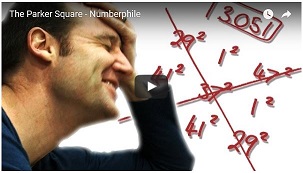
F U N !!! Matt Parker, an Australian living in UK, former maths teacher (https://en.wikipedia.org/wiki/Matt_Parker
and http://standupmaths.com/), tried
to solve the enigma #1 (3x3 magic square of squares) at  (YouTube
Numberphile
videos by Brady Haran). In his video, 1:02-1:36, he also presented the solution of the enigma #4c
(7x7 magic square of cubes) found in 2015 by Sébastien Miquel:
(YouTube
Numberphile
videos by Brady Haran). In his video, 1:02-1:36, he also presented the solution of the enigma #4c
(7x7 magic square of cubes) found in 2015 by Sébastien Miquel:
Invalid solution..., so no, I did not send any prize in euros
or any bottle of champagne to Matt! :-)
Received February 6 and March 1, 2017
Ben Asselstine, Canada, announced his "set
of tools for finding and managing 3x3 magic squares of squares" freely
available at http://fituvalu.nongnu.org/.
This software uses libgmp (GNU Multiprecision Arithmetic Library) for computing
on large integers, and is designed to be easily parallelizable with GNU Parallel.
He added this javascript program http://fituvalu.nongnu.org/checker.html:
"It lets people check their 3x3 magic squares with 6 or more (?) perfect squares
against a list of 100,000 known squares."
Received February 27, 2017
Lee Morgenstern sent PDFs of two articles written a few years ago, updated
versions of the broken links of 2006 :
Received March 10, 2017
Lee Morgenstern produced this 3x3 square,
using the new 6th triple of primitive Pythagorean triangles having equal areas found
by Duncan Moore a few days earlier:
|
19720769947309²
|
6757561171393²
|
11290071470263²
|
|
10987237357337²
|
9483582546853²
|
18745169816089²
|
|
7239541562993²
|
20650330341071²
|
9120965347253²
|
S = 562039114103450691451191099 for rows, columns, and one diagonal. Unfortunately
the other diagonal has a different sum.
Received from March 11 to 13, 2017
Randall Rathbun, USA, found the elliptic curve of rank 4
- y2 = x3 - x2 + 7528505392x + 671534074163712
giving the only previously known example with 7 squared entries. An excellent
work, because it is very difficult to find this curve. But unfortunately, thousands
of points on this curve (producing numbers with thousands of digits!) did not produce
any other magic square with 7 squared entries...
Details in the emails sent by Randall to Andrew Bremner
and me.
Received June 5, 2017
Christian Woll, California, USA, sent an interesting paper entitled
"The Magic Hourglass of Squares related to the Gaussian
Integers"
Received September 22, 2017
Joseph Hurban, when he was student tutor at TCNJ (College of New Jersey, USA), sent this nice formula producing 3x3
magic squares of 5 squares:
|
(10z² + 20z + 5)²
|
b = 7²(2z² + 1)²
- 4z(2z² + 101z + 1)
|
c = (2z² + 1)²
+ 8z(26z² + 38z + 13)
|
|
(2z² + 2z + 1)²
|
(10z² + 10z + 5)²
|
(14z² + 14z + 7)²
|
|
g = 7²(2z² + 1)²
+ 8z(24z² - 13z + 12)
|
h = (2z² + 1)²
+ 4z(102z² + 151z + 51)
|
(10z² - 5)²
|
Is it possible to obtain supplemental squared integers in cells b, c,
g, and h? With a MATLAB program, he tried to find solutions, and from
z = 0 to 1,000,000, found five solutions:
- z = 0 : b, c, g, h are squared integers, but the solution
does not use unique integers
- z = 1 : b, c, g, h are squared integers, but the solution
does not use unique integers
- z = 3 : c = 95², producing a 3x3 magic square of 6 squares
- z = 10: c = 529², producing a 3x3 magic square of 6 squares
- z = 12 : h = 937², producing a 3x3 magic square of 6
squares
Examples with z = 1, 2, 3:
|
35²
|
5²
|
25²
|
|
85²
|
2281
|
3169
|
|
155²
|
13825
|
95²
|
|
5²
|
25²
|
35²
|
13²
|
65²
|
91²
|
25²
|
125²
|
175²
|
|
25²
|
35²
|
5²
|
5281
|
6169
|
35²
|
22225
|
17425
|
85²
|
I checked that there is no other solution with more than 5 squared integers
for any z < 10^10.
Received November 15, 2017
Adrian Suter, Switzerland, working on Moriarty's results,
sent a paper unfortunately producing a 3x3 magic
square of non-distinct squares...
Received November 28, 2017
Benjamin Bartsch sent this parametric solution, similar to King's
solutions, producing 3x3 semi-magic squares:
|
(-2 - 6x - 7x2 - 2x3
- x4)2
|
(-2 + 5x2 + 4x3
+ 2x4)2
|
(-1 - 6x - 5x2 - 4x3
- 2x4)2
|
|
(-2 - 4x - 5x2 + 2x4)2
|
(-1 - 2x - 7x2 - 6x3
- 2x4)2
|
(-2 - 4x - 5x2 - 6x3
- x4)2
|
|
(1 - 2x - 7x2 - 8x3
- 2x4)2
|
(-2 - 8x - 7x2 - 2x3
+ x4)2
|
(2 + 2x + x2 + 2x3 +
2x4)2
|
Seven magic lines with S = 9 + 36x + 90x2 + 144x3 + 171x4
+ 144x5 + 90x6 + 36x7 + 9x8, one
diagonal being not magic with a different sum.
I remarked that with x = -8.6131187, we have a fully magic
square with eight magic lines.... but of course using non-integers :-)
Received April 25, 2018
Two years after his magic squares of 7 squares allowing imaginary
numbers, Eddie Gutierrez found a new 3x3 magic square of 7 squares,
this time linked to Bremner's square (www.oddwheel.com/special
squares.html),
S = 780300:
|
806425
|
(697i)²
|
678²
|
=
|
806425
|
-485809
|
459684
|
|
-86641
|
510²
|
779²
|
-86641
|
260100
|
606841
|
|
246²
|
1003²
|
(535i)²
|
60516
|
1006009
|
-286225
|
Thesis, May 2018
Giancarlo Labruna, Montclair State University (New Jersey, USA), submitted
a thesis entitled "Magic
Squares of Squares of Order Three over Finite Fields". Giancarlo is
now lecturer, School of General Studies, Kean University (New Jersey).
Published from September to November 2018
Christian Woll, after his above paper of June 2017,
published two new papers on arXiv:
Two examples of his Lunar magic squares of squares. On the left
in base 10, S = 24². On the right in base 2, S = 1011111.
|
22²
|
0²
|
14²
|
|
11²
|
101²
|
1001²
|
|
1²
|
24²
|
2²
|
110²
|
1011²
|
1²
|
|
4²
|
3²
|
23²
|
1010²
|
0²
|
111²
|
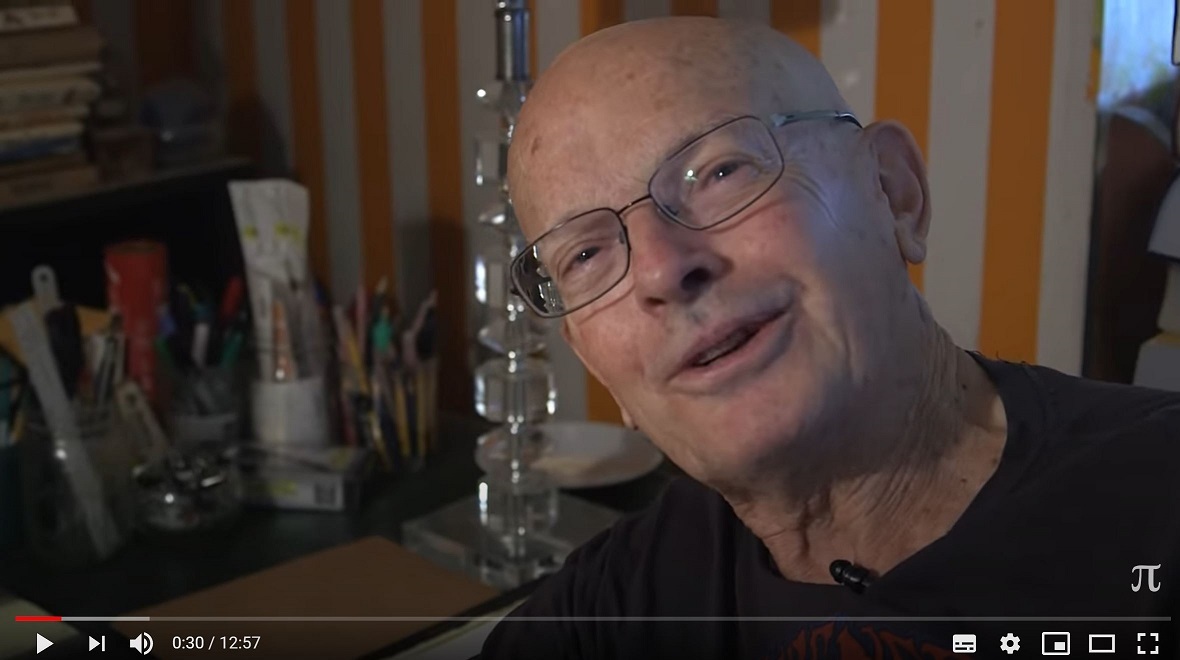
On Lunar arithmetic, and primes on the Moon, Numberphile video featuring Neil Sloane
(OEIS): https://youtu.be/cZkGeR9CWbk,
Nov. 2018.
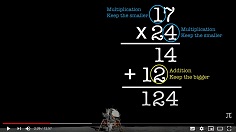

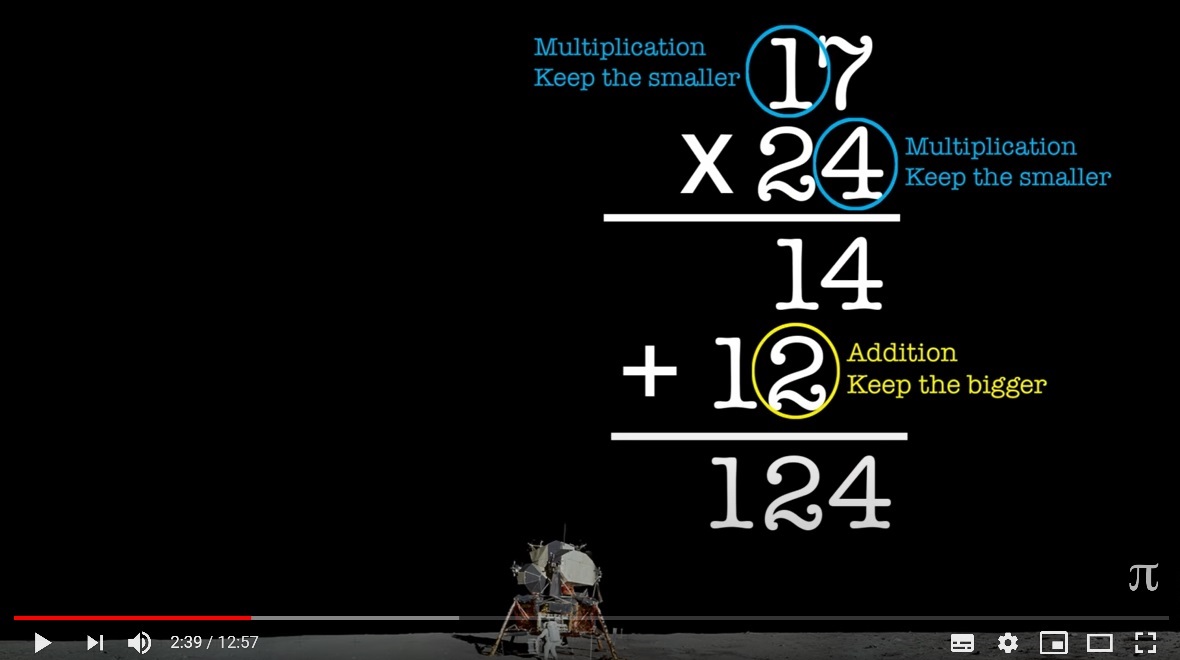
Lunar
addition, Lunar multiplication, and Neil Sloane
Received November 18, 2018
Vlad Volosatov, Russia, cleverly remarked that 3x3 magic squares of
squares are possible using quaternions (i² = j² = k² = ijk = -1).
For example, with S = -75 :
|
(5i)²
|
(7k)²
|
(j)²
|
=
|
-25
|
-49
|
-1
|
|
(k)²
|
(5j)²
|
(7i)²
|
-1
|
-25
|
-49
|
|
(7j)²
|
(i)²
|
(5k)²
|
-49
|
-1
|
-25
|
I add a remark: there is already a link between quaternions and 4x4
magic squares of squares!
Received December 30, 2018
Arkadiusz Wesolowski, Poland, found two parametric solutions
of 3x3 magic squares of 5 squared integers. With n >= 1, let
- x = -1 + [(sqrt(2)/2)*((3 + 2*sqrt(2))n - (3 - 2*sqrt(2))n) + (3 +
2*sqrt(2))n + (3 - 2*sqrt(2))n)]/2
Or equivalent, the value of x can also be obtained with this recurrence
formula:
- x = a(n) = 6*a(n-1) - a(n-2) + 4, starting with a(0) = 0 and a(1) =
4
Then we obtain this magic square, the integers in black being squared
integers:
|
17x4
+ 44x3
+ 34x2
+ 10x + 1
|
9x2 + 6x + 1
|
10x4
+ 28x3
+ 23x2
+ 8x + 1
|
|
2x4 + 8x3 + 11x2
+ 6x + 1
|
9x4 + 24x3 + 22x2
+ 8x + 1
|
16x4 + 40x3 + 33x2
+ 10x + 1
|
|
8x4
+ 20x3
+ 21x2
+ 8x + 1
|
18x4 + 48x3 + 35x2
+ 10x + 1
|
x4
+ 4x3
+ 10x2
+ 6x + 1
|
First examples with n = 1 (-> x = 4) and n = 2 (-> x = 28):
|
7753
|
13²
|
4753
|
|
11441977
|
85²
|
6779473
|
|
35²
|
65²
|
85²
|
1189²
|
2465²
|
3277²
|
|
3697
|
91²
|
697
|
5372977
|
3485²
|
710473
|
The other parametric solution is a derivative of the first one above. Again
with n >= 1:
- x = 1 + [(sqrt(2)/2)*((3 + 2*sqrt(2))n - (3 - 2*sqrt(2))n) +
(3 + 2*sqrt(2))n + (3 - 2*sqrt(2))n]/2
- or x = a(n) = 6*a(n-1) - a(n-2) - 4, starting with a(0) = 2 and
a(1) = 6
|
17x4
- 44x3
+ 34x2
- 10x + 1
|
9x2 - 6x + 1
|
10x4
- 28x3
+ 23x2
- 8x + 1
|
|
2x4 - 8x3 + 11x2
- 6x + 1
|
9x4 - 24x3 + 22x2
- 8x + 1
|
16x4 - 40x3 + 33x2
- 10x + 1
|
|
8x4
- 20x3
+ 21x2
- 8x + 1
|
18x4 - 48x3 + 35x2
- 10x + 1
|
x4
- 4x3
+ 10x2
- 6x + 1
|
First examples with n = 1 (-> x = 6) and n = 2 (-> x = 30):
|
13693
|
17²
|
7693
|
|
12612301
|
89²
|
7364461
|
|
35²
|
85²
|
115²
|
1189²
|
2581²
|
3451²
|
|
6757
|
119²
|
757
|
5958661
|
3649²
|
710821
|
In the two parametric solutions, the numbers increase quickly:
i.e. with n = 100, the magic sums are as big as ~2.38*10^307... However maybe,
for some values of n, cells in red can become (huge) squared integers,
giving 3x3 magic squares with more than 5 squared integers?
Received May-June, 2019
Onno M. Cain, USA, worked on a paper, later published in August 2019 on arXiv,
entitled "Gaussian Integers, Rings,
Finite Fields, and the Magic Square of Squares".
And, after Woll's paper on 3x3 magic squares of squares
on the Moon, Onno constructed this 3x3 magic square of squared Lunar primes:
|
1001101²
|
110101²
|
1010011²
|
|
111001²
|
1010111²
|
1011001²
|
|
1001011²
|
1011101²
|
1001111²
|
His papers (including this square) are available at https://sites.google.com/view/onnomc/papers,
and his software for Lunar Arithmetic calculations in Python is also available
at https://github.com/onnomc/lunar-arithmetic-wrapper
and https://repl.it/@onnomc/LunarArithmeticPlayground
Received June 24, 2019
Ben Asselstine published a PDF
of 41 pages, looking as a PowerPoint file, on the 3x3 magic square of squares problem, including his analysis
on magic squares of 6 squares.
Received September 16, 2019
Sunil Kumar, Tamil Nadu, India, 16 years old, found this near-miss of a 3x3 magic
square of 7 squares, S = 108329642031:
|
65118629677
|
49565²
|
201877²
|
|
108377²
|
190026² + 1
|
245915²
|
|
177385²
|
264127²
|
7101131677
|
Received December 20 and 22, 2019
One year after his above parametric solutions
of 3x3 magic squares of 5 squared integers, one more squared integer! Arkadiusz Wesolowski found this marvelous
parametric solution
of 3x3 magic squares of 6 squared integers:
- x = [(3 + sqrt(3))*(2 + sqrt(3))n+1 + (3 - sqrt(3))*(2 - sqrt(3))n+1]/6,
- y = [(3 + sqrt(3))*(2 + sqrt(3))n + (3 - sqrt(3))*(2 - sqrt(3))n]/6,
- z = 2n * [(1 + sqrt(3)/2)n+1 - (1 - sqrt(3)/2)n+1]/sqrt(3).
|
(xy - z)²
|
(xz + y)²
|
x² + y²z²
|
|
(x + yz)²
|
(x² + y²)(z² + 1)/2
|
(xz - y)²
|
|
x²z² + y²
|
(yz - x)²
|
(xy + z)²
|
The three first examples of 3x3 magic squares, constructed with n =
1 (-> (x, y, z) = (11, 3, 4)), n = 2 (-> 41, 11, 15), and n = 3 (->
153, 41, 56):
|
29²
|
47²
|
265
|
|
436²
|
626²
|
28906
|
|
6217²
|
8609²
|
5295025
|
|
23²
|
1105
|
41²
|
206²
|
203626
|
604²
|
2449²
|
39353665
|
8527²
|
|
1945
|
1²
|
37²
|
378346
|
124²
|
466²
|
73412305
|
2143²
|
6329²
|
When n is an even positive number, we can prove that the cells in red can't
be squared integers. His quick search of odd n <= 2*10^5 didn't produce
3x3 magic squares with seven, eight, or nine square numbers. But maybe a larger
odd n?
This was not given by Arkadiusz, but x, y, z can be easily computed with these recurrence
formulas:
- x(0) = 3
- y(0) = 1
- z(0) = 1
- x(n) = 3*x(n-1) + 2*z(n-1)
- y(n) = x(n-1)
- z(n) = x(n-1) + z(n-1)
Received January 18, 2020
And less than one month later, Arkadiusz Wesolowski found another marvelous
parametric solution
of 3x3 magic squares of 6 squared integers. The following identity expresses
the product of two sums of two squares as a sum of two squares in three different
ways.
- [(6n2 + 6n + 2)2 + (2n + 1)2] * [(3n2
+ 2n)2 + (3n2 + 4n + 1)2]
= (18n4
+ 48n3 + 43n2 + 16n + 2)2 + (18n4
+ 24n3 + 7n2 - 2n - 1)2
= (18n4
+ 42n3 + 37n2 + 14n + 2)2 + (18n4
+ 30n3 + 19n2 + 6n + 1)2
= (18n4
+ 36n3 + 29n2 + 10n + 1)2 + (18n4
+ 36n3 + 29n2 + 12n + 2)2
And since
- 2 * (18n4 + 42n3 + 37n2 + 14n + 2)2
= (18n4 + 48n3 + 43n2 + 16n + 2)2
+ (18n4 + 36n3 + 29n2 + 12n + 2)2
we can form a magic square with:
- w = 6n² + 6n + 2,
- x = 2n + 1,
- y = 3n² + 2n,
- z = 3n² + 4n + 1.
|
(wz + xy)²
|
(wy - xz)²
|
(2y² - z²)x² + (2z² - y²)w²
|
|
2(x²y² + w²z²) - (wy + xz)²
|
x²y² + w²z²
|
(wy + xz)²
|
|
x²z² + w²y²
|
2(x²y² + w²z²) - (wy - xz)²
|
(wz - xy)²
|
The three first examples of 3x3 magic squares, constructed with n = 1, 2,
3:
|
127²
|
46²
|
20062
|
|
878²
|
503²
|
905719
|
|
3191²
|
2162²
|
11588158
|
|
16702
|
113²
|
94²
|
778039
|
802²
|
713²
|
10220638
|
2969²
|
2722²
|
|
74²
|
23422
|
97²
|
617²
|
1033399
|
718²
|
2458²
|
12955678
|
2729²
|
I checked that the cells in red are not squared integers for any n < 10^10,
meaning magic sum < 9.72*10^82.
So difficult to obtain a 7th squared integer! But maybe possible for a larger
n ?
Received May 18, 2020
Three years after his first parametric solution, Joseph
Hurban sent this nice parametric solution of 3x3 magic squares of 4 squared
integers:
|
(qr - ps)²
|
[(qr)² + (ps)²
+ (pr)² + (qs)²]/2 + 4pqrs
|
(pr - qs)²
|
|
[3(pr)² + 3(qs)²
- (qr)² - (ps)²]/2
|
[(qr)² + (ps)²
+ (pr)² + (qs)²]/2
|
[3(qr)² + 3(ps)²
- (pr)² - (qs)²]/2
|
|
(qr + ps)²
|
[(qr)² + (ps)²
+ (pr)² + (qs)²]/2 - 4pqrs
|
(pr + qs)²
|
We can obtain a lot of solutions with two more squared integers, but again it
is very
difficult to obtain a 7th... Here are two examples of solutions with 6 squared integers,
obtained with (p, q, r, s) = (1, 3, 2, 11) and (1, 9, 5, 8):
|
5²
|
889
|
31²
|
|
37²
|
5089
|
67²
|
|
1561
|
25²
|
-311
|
6769
|
3649
|
23²
|
|
17²
|
19²
|
35²
|
53²
|
47²
|
77²
|
Dear readers and searchers,
Before sending me your results, don't reinvent the wheel!
Read
the top of this page. For example, yes, the below results are well known
and proved,
do not send them again.
If a 3x3 magic square of 9 squared integers exist (primitive,
with cells relatively prime), then all cells are odd, and all cells are 3k+1
->
all cells are 6k+1.
And no cell multiple
of 3, 11, 19, 43,... because already proved are:
1) the center cell
is a (squared) product of 4k+1 prime numbers = 5, 13, 17, 29, 37, 41,...
2)
the 4 cells middle-side are (squared) products of 8k+1 and/or
8k+7 prime numbers = 7, 17, 23, 31, 41, 47,...
3) the 4 corners are (squared)
products of 8k+1, +5, and/or +7 prime numbers = 5, 7, 13, 17, 23, 29,
31, 37, 41, 47,...
In a 3x3 magic square of 9 squared integers, if we accept that
some squared integers can be repeated, then any solution uses only
1 or 3
squared integers.
No other way, impossible with 2, 4, 5, 6, 7, or 8
distinct squared integers. But unknown for 9, that's the problem...
On the
left, the only possible family of solutions with repeated squared integers.
|
3x3 magic square of squares, S = 3c²,
with a²
+ b² = 2c²
|
|
Obvious 3x3 magic square of squares,
S
= 3,
constructed with (a, b, c) = (1, 1, 1)
|
|
3x3 magic square of squares, S = 75,
constructed
with (a, b, c) = (1, 7, 5)
|
|
a²
|
b²
|
c²
|
1²
|
1²
|
1²
|
1²
|
7²
|
5²
|
|
b²
|
c²
|
a²
|
1²
|
1²
|
1²
|
7²
|
5²
|
1²
|
|
c²
|
a²
|
b²
|
1²
|
1²
|
1²
|
5²
|
1²
|
7²
|
Return to the home page http://www.multimagie.com